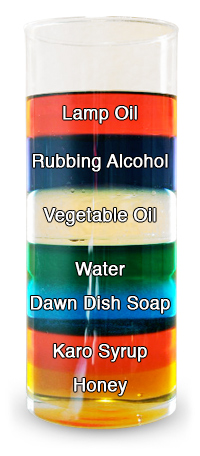
It is so important that schools adhere to a specific curriculum to help students learn the proper material they need to further continue their science experiences in the following years. For example, Ms. Drescher's class stumbled upon the concept of density and they were originally trying to study the volume of the liquids. All of the students experiences somehow intertwine together to be put to use when the students are learning about science in the future years of school. This is why it is so important that schools follow the proper curriculum in the classroom so that they don't forget any important moments in helping with the students learning. The fact that she was teaching them about volume and that led into another discussion about density is a perfect example of how the students need to learn the proper material the goes along with their classroom activities so that they can learn all the information, plus much more, that they need to expand their scientific minds.
So what is density really? Density is defined in the chapter as 'how closely packed together the particles are.' The real mathematical definition of density is 'the mass of an object divided by its volume.' If an object is less dense than the liquid it's in, then it floats to the top of the liquid. If an object is more dense than the liquid it's in, then it sinks to the bottom of the liquid.
In the science story that involves the eggs and the salt, it is important that students can see the message of how the salt water has an effect on the objects. Some questions that students may have about the Dead Sea are how much salt is actually in the Dead Sea as opposed to the other seas that contain less salt. One experimental design could be for the students to research the Dead Sea and it's actual salt content and compare it to a couple other seas that are around and find important information that compares and contrasts all the different seas. Then, they can do the same salt experiment in the classroom and the students can see how the different salt contents can affect the objects in the water.
I have experienced the 'spiraling' of activities in my science classes over many years of school. You feel like students always say they learn the same thing in elementary school every year and that does seem like it's true in some aspects. Even though I take science classes at a college level, teachers are still making references to the things that we learn in elementary school. For example, there are constant references of things in the solar system, like planets and outer space. Because I've been introduced to these concepts in both elementary and middle school it is a lot easier for me to grasp the concepts and understand the science behind them.

No comments:
Post a Comment